
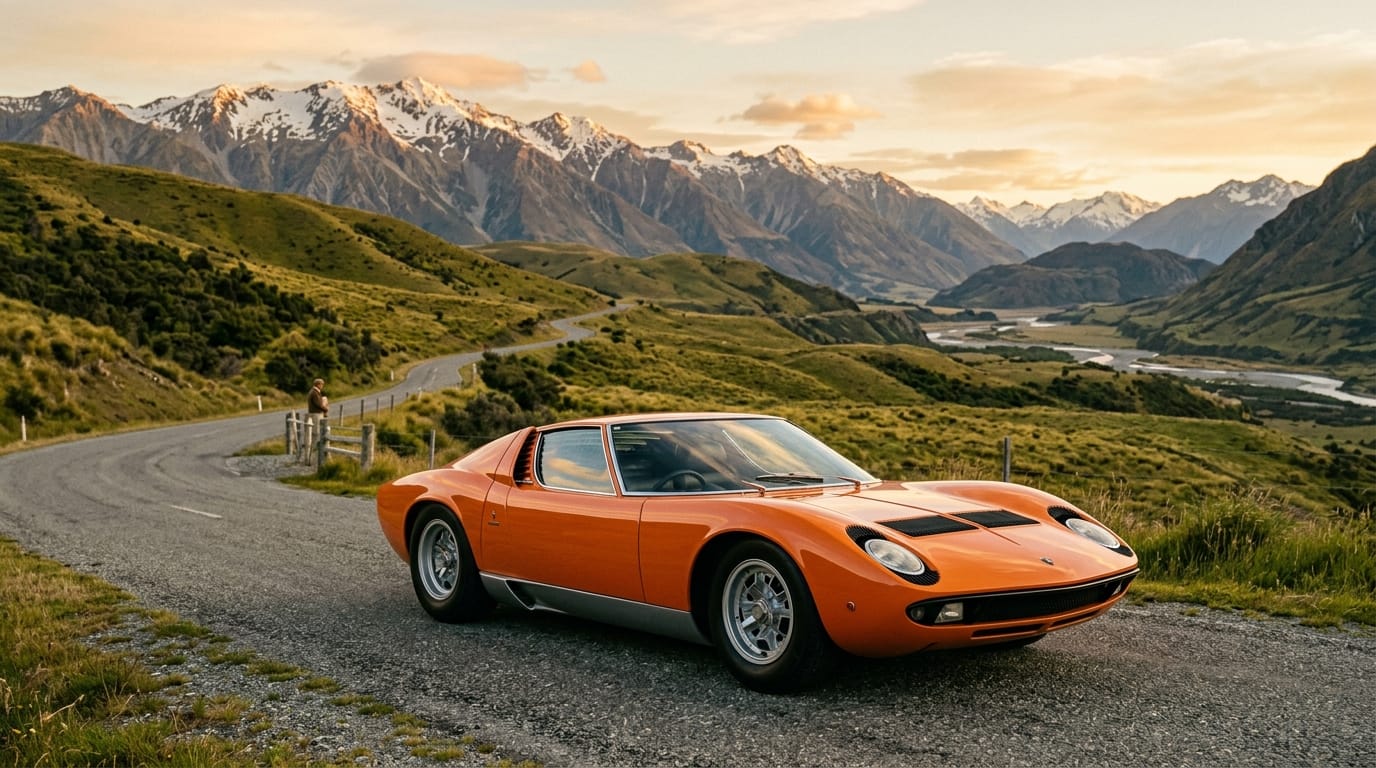
Modern supercars are faster, safer, easier to drive, and far more advanced than anything available in the 1960s. Yet one car from that era still shapes the way enthusiasts imagine a true exotic: the Lamborghini Miura.
In 2026, the Miura celebrates its 60th anniversary. Lamborghini first presented the production car at the Geneva Motor Show on March 10, 1966. Its low body, dramatic proportions, and V12 engine mounted behind the driver changed expectations almost immediately.
Lamborghini describes the Miura as the car that gave birth to the modern mid-engine super sports car. Six decades later, that influence remains easy to see in everything from the Countach and Diablo to today’s electrified Revuelto.
For Christchurch supercar fans, the anniversary is also a useful reminder of what makes a dream car memorable. Performance numbers matter, but sound, design, engineering, rarity, and emotion can matter just as much.
Our guide to hybrid supercars versus classic supercars in 2026 explores the same question from a modern driving perspective. The Miura represents the classic side of that debate better than almost any other car.
How the Miura Changed the Meaning of a Supercar
Before the Miura, many high-performance road cars followed a familiar layout. A large engine sat at the front, with the driver and passenger behind it.
Lamborghini took a very different path.
The Miura placed its V12 behind the passenger compartment and ahead of the rear wheels. The engine was also mounted sideways rather than lengthwise. This helped keep the wheelbase relatively short while placing much of the car’s mass near the centre.
The idea had strong links to racing-car design. Putting the engine near the middle could help create a more focused performance layout. However, packaging a large V12 and transmission into such a compact road car created major engineering challenges.
That willingness to ignore convention became part of the Miura’s identity.
A Mid-Engine V12 Made the Miura Feel Revolutionary
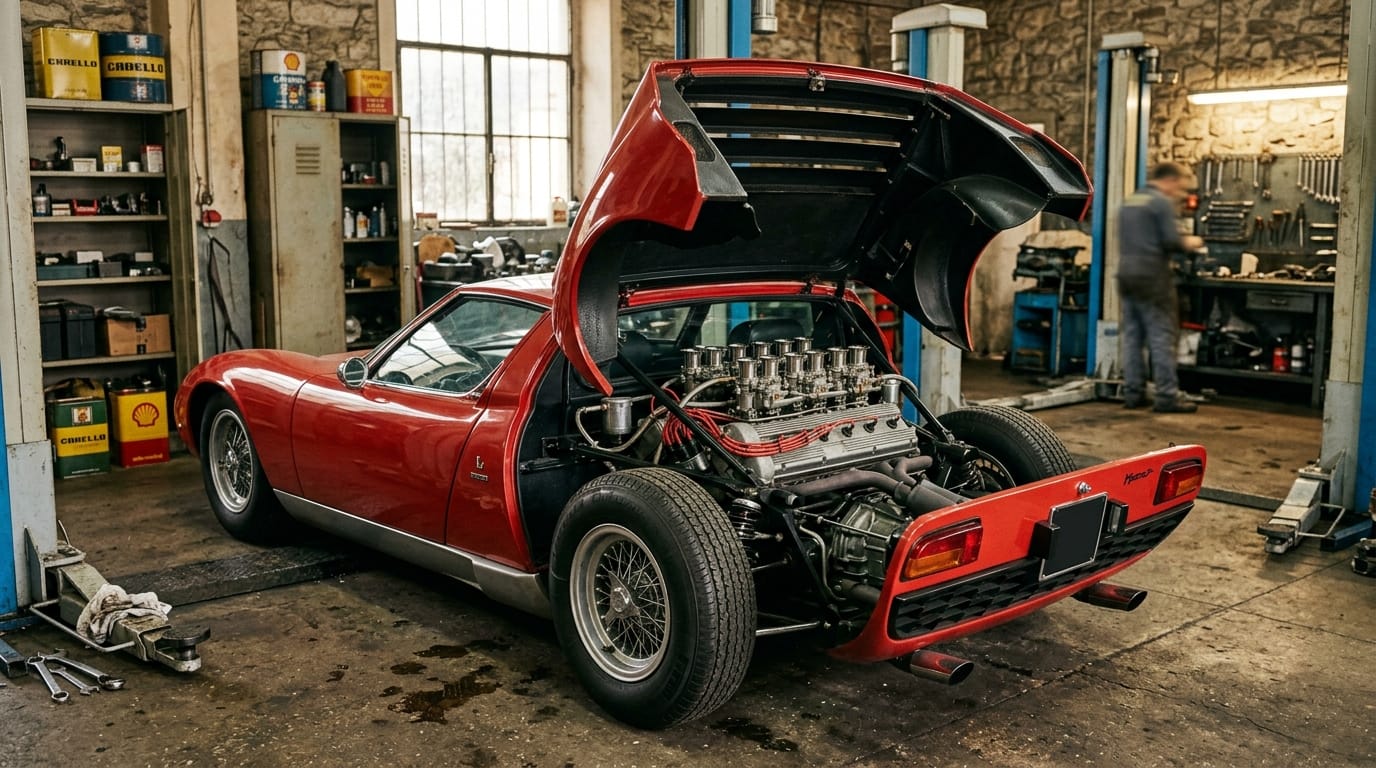
The original P400 used a 3.9-litre V12 producing about 350 horsepower. Later versions raised output, with the final Miura SV reaching about 385 horsepower.
Those numbers may not sound extreme next to a modern hybrid supercar producing more than 1,000 horsepower. In the mid-1960s, they were extraordinary.
Lamborghini says later Miuras could exceed 290 km/h. That placed the car among the fastest production vehicles of its era.
More important than the number was the way Lamborghini packaged the performance. The Miura was incredibly low and dramatic, with the engine placed where people expected to find luggage rather than twelve cylinders.
That idea became a blueprint. Mid-engine layouts later appeared across the exotic-car world and became closely associated with the idea of a supercar.
The Miura Was Created by a Remarkably Young Team
The Miura story also shows how new ideas often come from people willing to challenge established thinking.
Engineers Gian Paolo Dallara and Paolo Stanzani played central roles in developing the chassis and mechanical package. New Zealand-born test driver Bob Wallace also helped develop the concept and turn it into a usable high-performance road car.
Marcello Gandini, working at Bertone, created the famous body design.
The result looked unlike almost anything else on the road. The roof sat extremely low. The front end was smooth and simple. The headlights gained their famous eyelash-like surrounds, while the rear body flowed around the engine bay.
The proportions were shaped by engineering rather than by copying an existing sports car. That helps explain why the design still looks distinctive 60 years later.
The Miura Proved Performance Could Also Be Art
A supercar needs more than speed to become an icon.
The Miura became famous because it looked special before the engine even started. It had the visual drama that later became central to the Lamborghini identity.
The car also entered popular culture. It appeared in magazines, photography, and film, including the famous opening sequence of the 1969 movie The Italian Job.
That combination of engineering and visual theatre helped establish a formula that still defines exotic cars today.
A Ferrari, Lamborghini, McLaren, or another modern supercar is expected to deliver performance. It is also expected to create a sense of occasion when someone sees it parked outside a hotel or hears it approach on the road.
That emotional side of driving remains important around Christchurch too. Our article on motorsport-to-road experiences in Christchurch explains why the best performance-car experiences are about much more than simply chasing speed.
Why Lamborghini Is Celebrating the Miura So Heavily in 2026
Lamborghini is using the entire anniversary year to highlight the car’s importance.
The Lamborghini Museum in Sant’Agata Bolognese opened an exhibition called Born Incomparable in March 2026. It runs through January 2027 and traces the Miura’s development, special versions, engineering, and continuing influence.
The exhibition includes rare cars such as the one-off Miura Roadster and the extreme Miura SVJ. It also includes later Lamborghini models created as tributes to the original design.
The celebration has moved beyond the museum as well.
In May, Lamborghini Polo Storico organised a Miura anniversary tour through northern and central Italy. Twenty Miuras travelled through locations including the Piedmont hills, Ligurian coast, Florence, Mugello, and Imola.
The cars were not simply displayed indoors. Owners drove them across real roads, which highlights an important part of the Miura’s appeal: it remains a machine designed to move, sound, and feel alive.
The Revuelto Miura 60° Homage Connects 1966 With 2026
Lamborghini has also connected the anniversary directly with its current flagship.
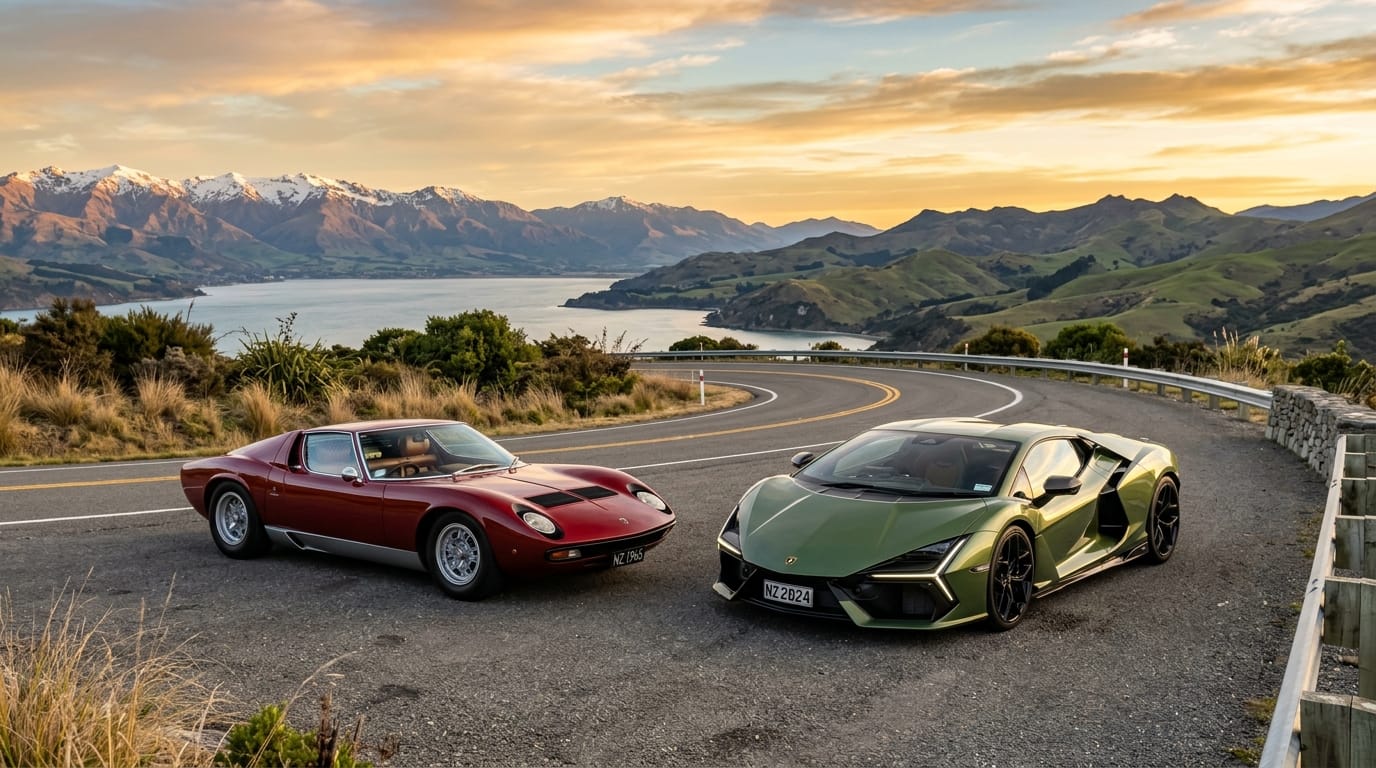
The Revuelto Miura 60° Homage uses modern Lamborghini technology while borrowing visual ideas from historic Miura colour combinations and details.
The contrast between the two cars is remarkable.
The Miura relies on a naturally aspirated V12, five-speed manual gearbox, direct steering, and almost no electronic assistance. The Revuelto combines a modern V12 engine with three electric motors, advanced electronics, all-wheel drive, and more than 1,000 horsepower.
Yet Lamborghini still sees the connection.
Both cars use a V12 as part of their character. Both place dramatic design alongside serious engineering. Most importantly, both were intended to move the idea of a Lamborghini forward rather than simply repeat an older formula.
This makes the Miura anniversary highly relevant to today’s hybrid-supercar debate.
Our Christchurch hybrid versus classic supercar guide looks at how drivers can choose between old-school mechanical emotion and modern electrified performance.
What the Miura Can Teach Modern Supercar Fans
No sensible buyer chooses a Miura because it offers the best performance per dollar in 2026.
A modern supercar can accelerate faster, brake harder, provide better crash protection, and offer far more predictable handling. Modern tyres, electronics, suspension, and aerodynamics have transformed what performance cars can do.
The Miura matters for another reason.
It reminds enthusiasts that memorable cars are not created by numbers alone.
A machine becomes special when design, sound, engineering, history, and emotion come together. That is why a 60-year-old Lamborghini can still share attention with cars that are several times more powerful.
The Best Dream Drive Is About Emotion, Not Maximum Speed
This lesson translates directly to a supercar experience in Christchurch.
Most customers will never explore the full performance limit of a modern exotic on a public road, nor should they. A scenic drive is not a race.
The real appeal comes from everything happening below that limit.
It is the way the steering feels on a flowing road. It is the view through the windscreen. It is the engine note when the road opens safely. It is the shape of the car reflected in a shop window or photographed against the Canterbury landscape.
A 600-horsepower car that makes the driver feel connected can create a better memory than a 1,000-horsepower machine used only to chase numbers.
The Miura understood that long before modern performance marketing existed.
It was dramatic at zero kilometres per hour. It made an event out of opening the door, sitting close to the ground, and hearing twelve cylinders start behind the seats.
Classic Supercar DNA Still Shapes the Cars We Want Today
Modern supercars may use hybrid systems, active aerodynamics, dual-clutch transmissions, digital displays, and sophisticated stability control. Their basic mission remains surprisingly familiar.
They are meant to feel different from ordinary transport.
The Miura helped establish that expectation.
Today’s Lamborghini Revuelto is vastly more capable, yet Lamborghini still points back to the Miura when explaining its identity. The Countach, Diablo, Murciélago, Aventador, and Revuelto all continue parts of the mid-engine V12 story that began in the 1960s.
The official Lamborghini history of the Miura and its 60th anniversary provides more detail about the car’s development, specifications, and influence.
For Christchurch enthusiasts, there is another useful takeaway. You do not need to own a museum-level classic to appreciate what the Miura represents.
You can look for those same qualities in a modern dream drive: dramatic design, an engine or powertrain with personality, a strong sense of occasion, and a route that makes the car feel memorable without needing irresponsible speed.
That is why the Miura still matters in 2026.
It is not the fastest Lamborghini anymore. It is not the most technologically advanced. It does not have the comfort or safety systems drivers now expect.
What it has is influence.
Sixty years after its Geneva debut, the Miura still helps define what enthusiasts mean when they use the word “supercar.” It turned engineering into theatre and gave the world a shape and layout that countless exotic cars would follow.
Modern performance continues to change, but the desire behind it remains familiar. We still want cars that make an ordinary road feel like an occasion.
The Lamborghini Miura was one of the first cars to understand that completely.